Types of PMO: Project, Program and Enterprise PMO
There are different types of PMOs, and they do not all have the same responsibilities or level of authority. Some PMOs mainly support project teams, while others control project processes or directly manage projects.
The structure of a PMO depends on what an organization needs. A company managing a few projects may use a small supportive PMO, while a large organization may have a PMO responsible for projects, programs, or an entire portfolio.
What Are the Types of PMO?
The term PMO, or Project Management Office, can describe different organizational structures. Understanding PMO in project management provides useful context for how these offices support projects, establish processes, and work with project teams. The way a PMO operates depends on its purpose, scope, and level of authority within the organization.
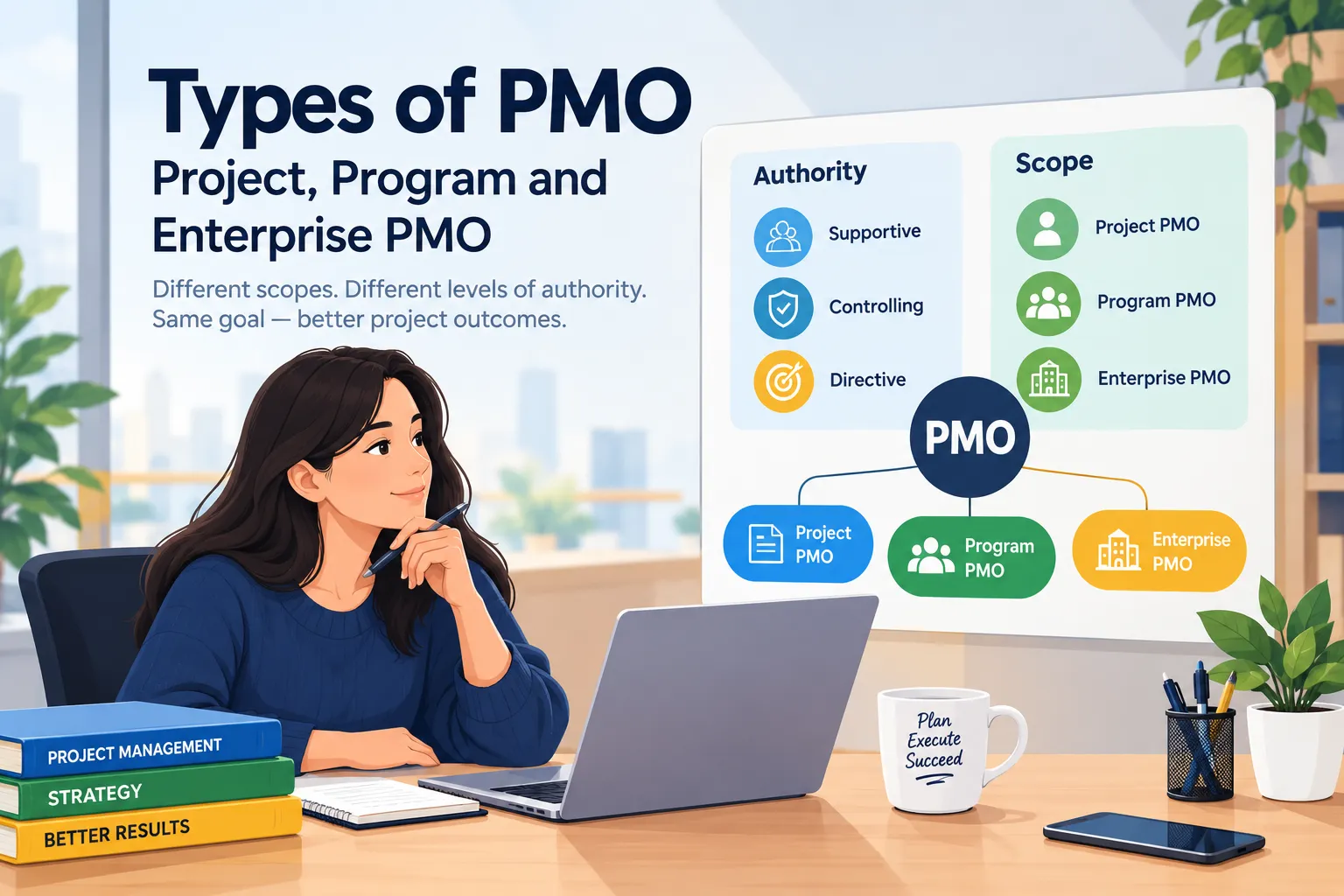
One common way to classify PMOs is by their level of authority: supportive, controlling, and directive. PMOs can also be described by their scope, such as project PMOs, program PMOs, and enterprise PMOs.
These classifications describe different aspects of a PMO, so they are not always mutually exclusive. A PMO can have a specific scope and also operate with a particular level of authority.
Supportive PMO
A supportive PMO mainly provides help and resources to project teams. Understanding what a PMO does can help explain how these responsibilities differ from the roles of controlling and directive PMOs. It usually focuses on giving teams the tools, guidance, and information they need rather than directly managing their projects.
It may offer project management templates, guidance, training, tools, and best practices without having significant authority over how individual projects are managed.
A supportive PMO is often useful when project teams already have project managers but need a common source of guidance and resources.
What Does a Supportive PMO Do?
A supportive PMO may:
- Provide project templates
- Offer training and guidance
- Share project management resources
- Provide recommended processes
- Help project managers with documentation
- Collect basic project information
- Share lessons learned
The project manager generally retains responsibility for managing the project. The PMO mainly acts as a source of support rather than directing day-to-day project decisions.
Controlling PMO
A controlling PMO has more authority than a supportive PMO. It can establish standards and processes that project teams are expected to follow.
Its role can include establishing project management standards and checking whether project teams are following required processes. This can help create more consistent project practices across an organization.
A controlling PMO may require teams to use specific templates, reporting formats, approval procedures, or project management methods.
What Does a Controlling PMO Do?
A controlling PMO may:
- Establish mandatory project standards
- Monitor compliance
- Define reporting requirements
- Review project documentation
- Maintain governance processes
- Track project performance
- Support project audits or reviews
The amount of control can vary between organizations. Some controlling PMOs may focus mainly on standards and reporting, while others can have a broader role in project governance.
Directive PMO
A directive PMO has a higher level of authority over project management. Instead of simply providing guidance or monitoring processes, it may take direct responsibility for managing projects.
Rather than simply providing guidance, it may directly manage projects and assign project managers to them. This gives the PMO a more active role in project execution and delivery.
The PMO can therefore have responsibility for project delivery as well as project standards and reporting.
What Does a Directive PMO Do?
A directive PMO may:
- Assign project managers
- Direct project teams
- Manage project delivery
- Establish project standards
- Monitor project performance
- Manage project reporting
- Coordinate project resources
- Support governance and decision-making
This type of PMO has a more direct relationship with project execution. Project managers may work within the PMO structure rather than operating independently from it.
Supportive vs Controlling vs Directive PMO
The main difference between these three PMO types is the level of authority they have. Supportive PMOs generally provide assistance, controlling PMOs establish and monitor standards, and directive PMOs take a more direct management role.
| PMO Type | Main Role | Level of Authority |
|---|---|---|
| Supportive | Guidance, tools, and resources | Lower |
| Controlling | Standards, processes, and compliance | Moderate |
| Directive | Direct project management | Higher |
These descriptions are general. An organization’s actual PMO responsibilities may not fit perfectly into one category, and the level of authority can vary depending on how the PMO is structured.
Project PMO
A project PMO focuses on a specific project or a small group of closely related projects. Its work is usually centered on the needs and requirements of that particular initiative.
Its role can include project planning, reporting, documentation, risk tracking, governance, and coordination. The exact responsibilities can change depending on the size and complexity of the project.
Because its scope is limited, a project PMO can work closely with the project team and focus on the requirements of that particular initiative.
What Does a Project PMO Do?
A project PMO may:
- Maintain the project plan
- Track project milestones
- Prepare status reports
- Maintain project documentation
- Track risks and issues
- Support project meetings
- Coordinate project information
- Support project governance
The exact responsibilities depend on the project and organization. A project PMO may provide administrative support in one organization and take on a much more active role in another.
Program PMO
A program PMO supports a program made up of multiple related projects. Its focus is broader than a project PMO because it needs to consider how several projects work together.
Instead of focusing on just one project, the program PMO helps coordinate projects that are connected through a broader business objective.
It may monitor dependencies between projects, consolidate reporting, coordinate resources, and support program-level governance. This gives program leadership a clearer view of how the related projects are progressing.
What Does a Program PMO Do?
A program PMO may:
- Coordinate related projects
- Track dependencies
- Consolidate project reports
- Support program planning
- Monitor program-level risks
- Coordinate resources
- Maintain program documentation
- Support program governance
The goal is to provide a coordinated view of the projects within the program. This can help identify dependencies, risks, and issues that may affect multiple projects.
Enterprise PMO
An enterprise PMO, often called an EPMO, operates at an organization-wide level. Its scope can cover projects and programs across multiple departments or business units.
Instead of focusing on one project or program, it can support project and portfolio management across different departments or business units.
An enterprise PMO may establish organization-wide standards, provide portfolio reporting, support governance, and help align project activity with broader organizational objectives.
What Does an Enterprise PMO Do?
An enterprise PMO may:
- Establish organization-wide project standards
- Provide portfolio-level reporting
- Support governance
- Coordinate resources across business areas
- Standardize project processes
- Monitor project and program performance
- Support strategic alignment
- Provide guidance to different PMOs
The scope of an enterprise PMO is generally broader than that of a project or program PMO. Its work can involve multiple projects, programs, departments, and business areas.
Project PMO vs Program PMO vs Enterprise PMO
These PMO types mainly differ in the scope they cover. A project PMO works at the individual project level, while program and enterprise PMOs operate across broader groups of work.
| Type | Main Focus | Typical Scope |
|---|---|---|
| Project PMO | Individual project | One project |
| Program PMO | Related projects | One program |
| Enterprise PMO | Organization-wide initiatives | Multiple programs and projects |
A project PMO may focus on the details of one initiative, while an enterprise PMO can provide a broader organizational view. A program PMO sits between these levels by coordinating related projects within a larger program.
PMO Types by Scope
Looking at PMOs by scope helps explain where their responsibilities sit within an organization. The scope can range from one project to multiple projects and programs across the entire organization.
Project-Level PMO
A project-level PMO works closely with one project. It may provide planning, reporting, documentation, and coordination support throughout the project lifecycle.
The PMO can also help the project team maintain records, track progress, and organize information needed for project reporting and governance.
Program-Level PMO
A program-level PMO coordinates multiple related projects. It can help manage dependencies and provide consolidated information about the overall program.
This broader view allows the PMO to track how individual projects contribute to the program and identify issues that may affect several related projects.
Enterprise-Level PMO
An enterprise-level PMO operates across the organization. It may establish common standards, support portfolio reporting, and provide governance across multiple business areas.
Because of its broader scope, an enterprise PMO may also work with different project and program PMOs to improve consistency and provide organization-wide visibility.
Can a PMO Have More Than One Role?
Yes. A PMO can have a particular scope and also operate with a specific level of authority. These two classifications can be used together to describe how a PMO actually works.
For example, an enterprise PMO could provide controlling functions by establishing mandatory project standards. A project PMO could operate in a supportive role by providing templates and guidance to a project team.
This is why PMO classifications should be viewed as ways of describing the PMO rather than rigid categories that apply to every organization. The exact PMO responsibilities can differ based on the organization’s structure and needs.
How Do You Choose a PMO Type?
The appropriate PMO structure depends on the organization’s project environment and what it needs the PMO to accomplish. There is no single structure that works equally well for every organization.
An organization may need more support if project teams are independent but require common resources and guidance. It may need stronger controls when consistent processes and reporting are important.
Organizations with many related projects may also need a program-level structure, while companies managing projects across multiple departments may consider an enterprise-level PMO.
PMO Structure and Authority
PMO structure determines how the office interacts with project teams and management. It also affects how much responsibility the PMO has for standards, reporting, governance, and project delivery.
A supportive structure gives project teams more independence, while a controlling structure places more emphasis on following common processes.
A directive structure gives the PMO greater responsibility for project management itself. The right structure depends on how much authority the organization wants the PMO to have.
How PMO Types Affect Project Teams
Different PMO types can change how project teams interact with the PMO. The team’s level of independence and the amount of reporting required can depend on the PMO’s authority.
With a supportive PMO, a project manager may mainly use the office for templates, guidance, training, or advice. The project team usually keeps more control over day-to-day project decisions.
With a controlling PMO, the project team may need to follow defined processes and provide regular reports. With a directive PMO, the project manager may work directly under the PMO’s management structure.
PMO Types and Governance
PMO governance can vary depending on the PMO’s authority and scope. A PMO with limited authority may provide recommendations, while a PMO with greater authority can establish required governance processes.
A supportive PMO may provide recommended governance practices, while a controlling PMO may establish required governance processes.
A directive or enterprise PMO may have a broader role in project approvals, oversight, reporting, and escalation. The specific governance structure should match the organization’s project environment.
Which PMO Type Is Used by a Company?
There is no universal PMO structure used by every company. Organizations design PMOs according to factors such as their size, number of projects, organizational structure, project complexity, and management requirements.
Some organizations may have one PMO, while others may have several PMOs operating at different levels. Their responsibilities can also vary depending on how much authority each PMO has.
For example, an organization could have a project-level PMO supporting a major initiative, a program PMO coordinating related projects, and an enterprise PMO providing organization-wide standards.
PMO Types in Simple Terms
The different types can be understood through two simple questions:
How much authority does the PMO have?
Supportive PMOs generally provide help, controlling PMOs establish and monitor standards, and directive PMOs take a more direct role in managing projects.
How broad is the PMO’s scope?
A project PMO focuses on a project, a program PMO coordinates related projects, and an enterprise PMO operates across the organization.
Looking at both authority and scope gives a clearer picture of how a particular PMO operates. A PMO can therefore be described by both the level it operates at and the amount of authority it has.
Frequently Asked Questions
What are the main types of PMO?
Common PMO types include supportive, controlling, and directive PMOs. PMOs can also be classified by scope as project, program, or enterprise PMOs.
What is a supportive PMO?
A supportive PMO provides guidance, templates, training, tools, and other resources to project teams. It generally has limited authority over project management decisions.
What is a controlling PMO?
A controlling PMO establishes project standards and monitors whether teams follow required processes, reporting methods, and documentation requirements.
What is a directive PMO?
A directive PMO has greater authority over project management and may directly manage projects or assign project managers.
What is a project PMO?
A project PMO focuses on a specific project. It may support planning, reporting, documentation, risk tracking, coordination, and project governance.
What is a program PMO?
A program PMO supports multiple related projects within a program. It can coordinate dependencies, reporting, resources, risks, and program-level governance.
What is an enterprise PMO?
An enterprise PMO operates across an organization and can establish common standards, support governance, coordinate reporting, and provide visibility across multiple projects and programs.
Can one organization have multiple types of PMO?
Yes. A large organization can have PMOs operating at project, program, and enterprise levels. Their responsibilities can also differ based on their level of authority.
Final Answer
The PMO full form is Project Management Office, and its meaning can be understood through both authority and scope. Supportive, controlling, and directive PMOs describe how much authority a PMO has, while project, program, and enterprise PMOs describe the level at which it operates.
A PMO may combine these characteristics. For example, an enterprise PMO can have controlling responsibilities, while a project PMO may mainly provide support.
The structure depends on the organization’s projects, teams, and management needs. Understanding both the PMO’s scope and authority makes it easier to see how that PMO fits within the organization.