Startup Booted Fundraising Strategy and Financial Modeling Explained
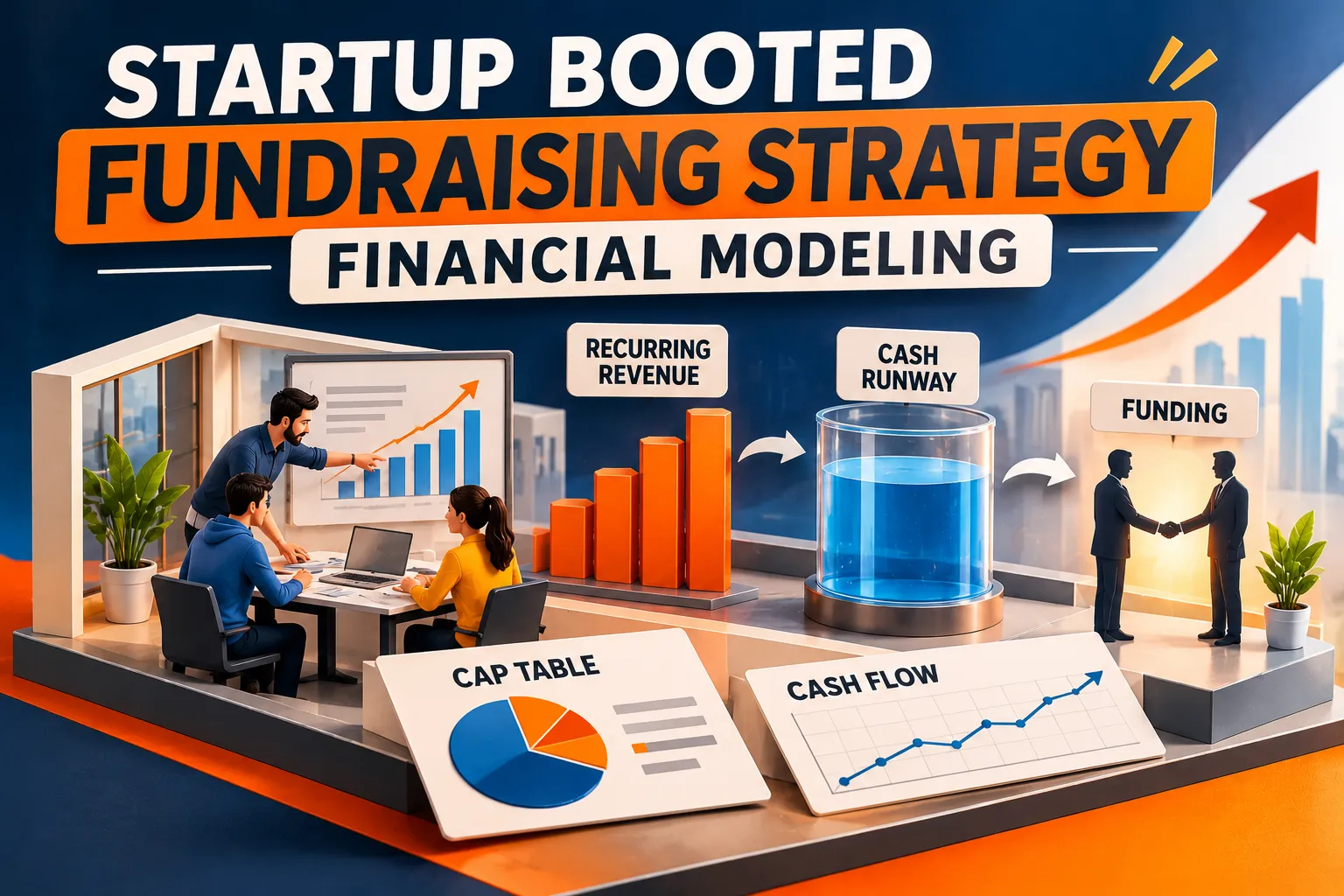
If you have searched for startup booted, you are probably trying to figure out how to fund a young company without giving away too much of it. The phrase itself causes some confusion, because most people mean “bootstrapped,” while a few searches lead to a consulting brand with a similar name. Behind both, the core question is the same: how do you grow on your own revenue, and when does outside money make sense?
This guide explains what the phrase means, how bootstrapping compares with venture funding, and how to decide whether a fundraising round is worth the cost. It also walks through a practical approach to financial modeling, shows how dilution works, and covers the metrics investors ask about. Where examples are used, they are hypothetical, so you can adapt them to your own numbers.
What Does Startup Booted Mean?
In everyday use, “startup booted” is almost always a misspelling of “bootstrapped.” A bootstrapped startup is funded from the founders’ savings and the revenue the business earns, rather than from outside investors. Many founders still raise money later, so a booted approach is best understood as a sequence: prove the business works first, then raise only when it clearly helps.
The phrase also appears as the name of a consulting business that offers pitch decks, financial modeling, and fundraising advice. Descriptions of that company vary from one website to another, and prices reported online were inconsistent, so check its official site directly before paying for any service. Nothing in this guide depends on hiring anyone.
Bootstrapping vs Venture Capital
Both paths can build successful companies, but they reward different strengths and carry different risks. The table below compares the main differences.
| Factor | Bootstrapped | Venture-backed |
|---|---|---|
| Source of money | Founder savings and customer revenue | Investors who buy equity |
| Ownership | Founders keep most or all of the company | Each round dilutes the founders |
| Growth pace | Set by what cash flow can support | Can be accelerated with investor capital |
| Pressure | Staying profitable and avoiding cash shortages | Hitting ambitious growth targets |
| Best fit | Businesses that can earn revenue on modest capital | Markets that reward speed or need heavy upfront spending |
Neither path is automatically better. The right choice depends on how much capital the business truly needs, how quickly it must grow to win its market, and how much control the founders want to keep. Understanding how established financial firms operate can also provide useful context, and this look at a major financial company offers another perspective on the industry.
When Should a Bootstrapped Startup Raise Money?
The most useful question is not “Can we raise?” but “What will this money buy that our revenue cannot buy in a reasonable time?” If the answer is a specific milestone, such as hiring a sales lead for a channel that already converts, the raise has a clear purpose. If the answer is vague, the company may not be ready.
Several signals suggest a business is in a stronger position to raise:
- Revenue grows steadily for several months, not just in one spike.
- Customers stay, so churn is stable or falling.
- At least one sales channel works, and more money would clearly scale it.
- The company has enough runway to negotiate without pressure, often considered to be at least nine to twelve months.
A founder who can state the purpose of the raise in one sentence, along with the expected result six months later, is usually in a better position than one who is raising simply to extend the runway.
Startup Booted Fundraising Strategy, Step by Step
A sound fundraising strategy starts well before the first investor meeting. It answers four questions: whether outside capital is needed, how much is needed, what form it should take, and what it will change.
- Know your numbers. Be ready to explain monthly revenue, growth rate, churn, customer acquisition cost, and runway without looking them up.
- Set a target tied to milestones. Calculate what the next stage requires, and divide that amount into specific costs.
- Choose the instrument. A small early raise often uses a convertible instrument, while a larger round usually involves a priced equity deal.
- Prepare the materials. A clear deck, a financial model, a cap table, and customer contracts should be ready before anyone asks.
- Plan for the no. Decide in advance which costs you would cut if the round takes longer than expected or does not close.
Keep the process disciplined. Share detailed financial information only with investors who have shown real interest, and treat any deal as a legal decision that needs a qualified lawyer’s review.
Funding Options Compared
Different funding sources suit different stages. The table below summarizes the most common options a bootstrapped company considers.
| Option | How it works | Main trade-off |
|---|---|---|
| Self-funding | Savings, family support, or retained revenue | Full control, but personal financial risk |
| SAFE | A contract that converts to equity in a later priced round | Simple and fast, but the valuation cap affects future dilution |
| Convertible note | Debt that converts to equity later | Carries interest and a maturity date |
| Priced equity round | Investors buy shares at an agreed valuation | Board seats and more detailed legal terms |
| Bank or government-backed loan | Repayable debt with a required plan | No ownership loss, but fixed repayments |
| Grants | Competitive funding for eligible projects | Time-consuming applications and limited eligibility |
Where grants are relevant, check the current program rules on the official agency website, because eligibility and funding windows change over time.
Startup Booted Financial Modeling: Build a Practical Model
A financial model is a forecast of revenue, costs, and cash. It does not need to be complicated. A simple monthly model with clear assumptions is more useful than a detailed spreadsheet nobody updates.
Most models rely on three statements. The profit and loss statement shows revenue minus costs over a period. The cash flow statement tracks the money actually moving in and out, which determines how long the business can survive. The balance sheet shows what the company owns and owes at a given moment.
A Hypothetical Example
Imagine a software business that charges $49 per month per customer. It starts with $40,000 in cash, has $4,000 in fixed monthly costs, and pays variable costs equal to 15 percent of revenue. It adds 10 new customers in month one, then two more each month, and loses no customers for simplicity. These are illustrative figures for teaching only.
| Month | Customers | Revenue | Total costs | Net cash flow | Cash at month end |
|---|---|---|---|---|---|
| 1 | 10 | $490 | $4,074 | -$3,584 | $36,417 |
| 2 | 22 | $1,078 | $4,162 | -$3,084 | $33,333 |
| 3 | 36 | $1,764 | $4,265 | -$2,501 | $30,832 |
| 4 | 52 | $2,548 | $4,382 | -$1,834 | $28,998 |
| 5 | 70 | $3,430 | $4,515 | -$1,085 | $27,914 |
| 6 | 90 | $4,410 | $4,662 | -$252 | $27,662 |
In this base case, the company still burns cash in month six, but the gap is closing. Now test a weaker scenario, where new customer additions are half as high. Cash at month six would fall to about $21,831, and the monthly loss would remain above $2,000. That tells the founder to plan for slower growth, reduce costs earlier, or raise a smaller amount.
Update the model with real numbers every month. Compare forecasts against actual results, and adjust the assumptions when they prove wrong.
Runway and Cash Management
Runway is the number of months your cash can cover at your current net burn. If you have $30,000 and lose $3,000 a month, your runway is about ten months. Revenue growth changes this over time, which is why a model is more useful than a single number.
Several practical habits protect runway. Invoice promptly, offer annual plans where customers are willing to pay upfront, separate fixed costs from variable ones, and set a trigger point in advance, such as cutting specific expenses if runway falls below six months.
Metrics Investors Usually Ask About
Investors want to know whether demand is real, whether customers stay, and whether growth is efficient. The following metrics are the ones most often discussed.
| Metric | What it tells an investor |
|---|---|
| Monthly recurring revenue and growth rate | Whether demand is real and accelerating |
| Churn rate | Whether customers stay long enough to be valuable |
| Customer acquisition cost (CAC) | How much it costs to win one customer |
| Lifetime value (LTV) | The gross profit a customer generates over their relationship with the company |
| Payback period | How many months it takes to recover acquisition cost |
| Burn rate and runway | How long the business can operate |
A common formula for LTV is average revenue per customer, multiplied by gross margin, divided by monthly churn. Payback is commonly calculated as CAC divided by monthly gross profit per customer. A ratio of LTV to CAC around 3 to 1 is often cited as a rough guide, though the right benchmark depends on the business model and stage.
Understanding Dilution
Every time a company sells new shares, the existing owners own a smaller percentage. This is dilution, and it is one of the main reasons founders bootstrap before raising.
A hypothetical example shows how it adds up. Suppose founders own 100 percent. They raise $500,000 through a SAFE with a $5 million post-money cap, which gives the investor roughly 10 percent once it converts. Later they raise $3 million in a priced round at a $15 million post-money valuation, selling 20 percent. After both rounds, founders own about 72 percent, before counting any employee option pool. Real deals have more terms, so have a lawyer confirm the actual numbers.
Common Mistakes to Avoid
Several mistakes come up again and again among founders who raise money. Raising before there is proof usually leads to worse terms. Modeling only the best case leaves no room for bad months. Ignoring churn makes growth look better than it is. Confusing profit with cash can sink a profitable business when customers pay late. Finally, refusing outside capital on principle can be costly if a well-funded competitor is winning the market.
Real Companies That Grew With Little Outside Capital
Several well-known companies built significant businesses with little or no venture funding for years. Mailchimp, founded in 2001, was acquired by Intuit in 2021 in a deal widely reported at about $12 billion. Basecamp, run by 37signals, is often cited as a profitable company that stayed largely self-funded, although it did take a minority investment from an outside investor in 2006. Atlassian grew for years before outside investors bought shares in a later secondary sale.
These examples are useful, but they are exceptions. Most startups fail regardless of funding path, and survivorship stories can hide the many companies that did not succeed.
Frequently Asked Questions
What does startup booted mean?
It usually refers to a bootstrapped startup, meaning a company funded by its founders and its own revenue. The phrase is not a formal financial term.
What is a startup booted fundraising strategy?
It is a plan for raising outside money from a position of strength. It involves knowing your numbers, raising for specific milestones, choosing the right instrument, and understanding the dilution.
What is startup booted financial modeling?
It is a simple monthly forecast of revenue, costs, and cash, usually with base and weaker scenarios, so you can see how long the business can last and which assumptions matter most.
Is startup booted the same as bootstrapping?
They overlap. Bootstrapping means funding the company from savings and revenue. Startup booted, as commonly used, also includes a plan for if and when outside money makes sense.
Can a bootstrapped company still raise venture capital?
Yes. Many founders prove demand first and raise on better terms. Strong revenue, retention, and clear unit economics improve negotiating power.
How much runway should a company have before raising?
There is no universal rule. Many founders aim for roughly nine to twelve months so they can negotiate without pressure, but the right figure depends on the market and burn rate.
Do I need a lawyer to raise money?
Usually yes. A startup lawyer should review any SAFE, convertible note, or term sheet before you sign.
Is the startupbooted.com consulting service the same as the concept?
No. The website is a commercial brand, while the phrase itself is widely used to describe a bootstrapped approach. Check the official site and its terms directly before deciding whether any service fits your needs.
Final Thoughts
Startup booted is best understood as a disciplined way to build a company: prove the business on revenue, keep control for as long as it makes sense, and raise outside money only for a clear purpose. A good fundraising strategy and a practical financial model make that discipline possible, because they show exactly what the money buys and how long the company can last without it.
Start with your numbers, build a simple model you can update every month, and treat every funding decision as a legal and financial choice that deserves careful review.