What Does MYF Meaning in Text Mean? Meanings, Uses and Examples
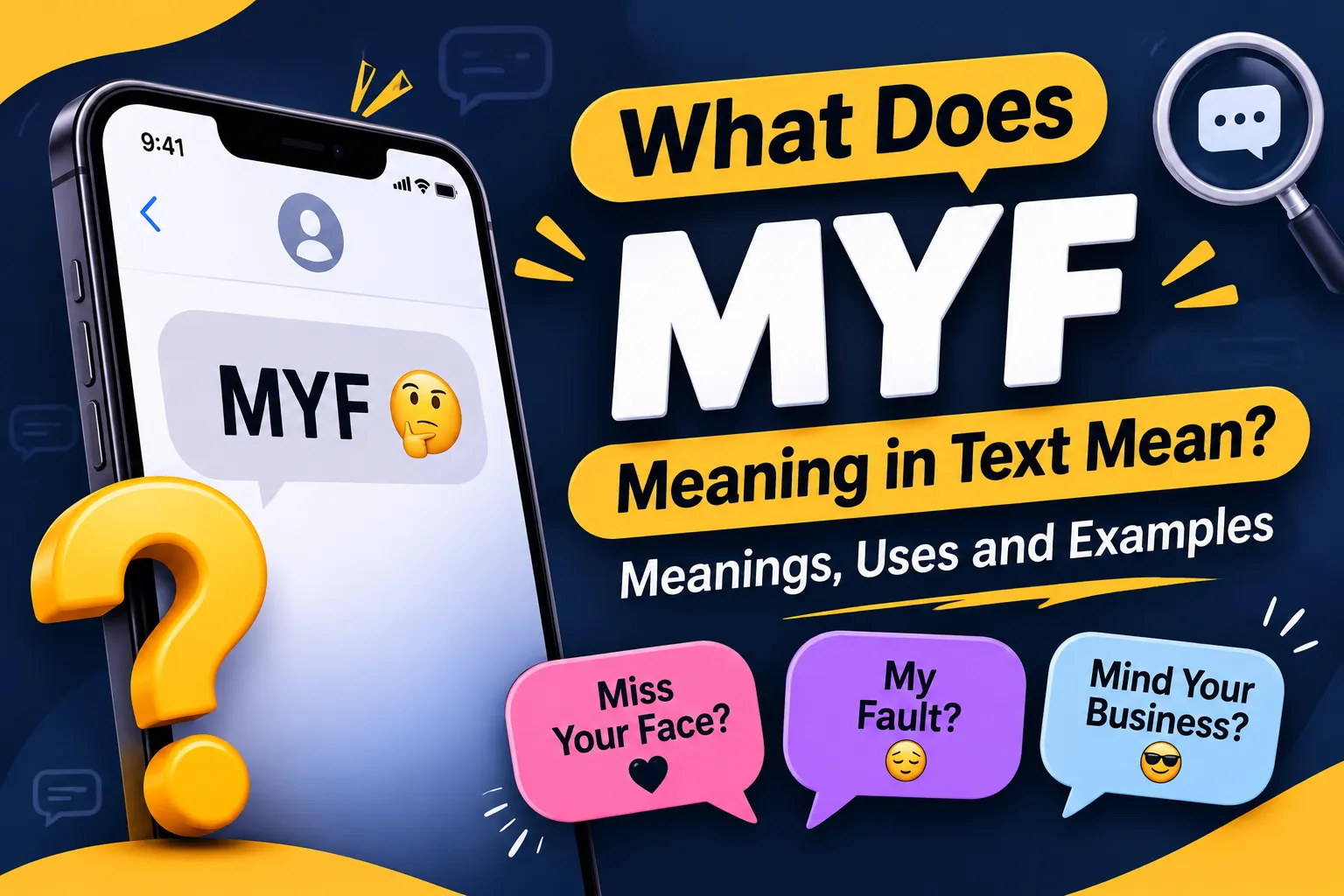
If you have just received a text, DM or Snap with “MYF” in it, you are not alone in wondering what it means. People search for myf meaning in text every day, and the honest answer is that MYF has no single official definition. It is internet slang, and like most slang, its meaning depends on who sent it, where it appeared and what the conversation was about before.
The good news is that most MYF messages fall into three common readings. It can mean “Miss Your Face,” “My Fault” or “Mind Your Business.” Once you know these three, the message becomes much easier to decode. The rest of this guide explains each meaning, shows how context changes it and gives you practical ways to respond without misreading the situation.
What Is the Meaning of MYF?
If you are asking what is the meaning of myf, the quick answer is that it is a short form of a longer phrase, and the phrase depends on the situation. Most readers will see one of the three meanings below. The table gives you a fast comparison before we look at each one in detail.
| Meaning | Typical Tone | Where You Usually See It | Example |
|---|---|---|---|
| Miss Your Face | Warm, affectionate | Private DMs, close-friend texts | “Had fun today, MYF already 🥹” |
| My Fault | Casual apology | Group chats, gaming lobbies, comments | “Sent that to the wrong chat, MYF” |
| Mind Your Business | Blunt, playful or annoyed | Public comments, teasing threads | “MYF, I’ve got this” |
Because MYF is not a standardized abbreviation, you will not find it in most formal dictionaries as a fixed term. Different online sources also rank these meanings differently, so the most useful approach is to treat them as possibilities and then use context to choose the right one.
MYF Meaning in Slang Across the Three Main Readings
The myf meaning slang question usually comes up when someone feels confused by a short message that does not match what they expected. Slang works this way because people shorten phrases they use often. Each of the three MYF readings comes from a phrase that people already say in everyday life, which is why they feel natural once you see them in context.
Miss Your Face
This is the warm version of the abbreviation. Instead of saying “I miss you,” someone writes “miss your face,” which feels a little more personal and playful. It suggests the sender is picturing the actual person, not just thinking about the idea of them.
You will usually see this meaning between close friends, family members or partners. It often appears after a fun meetup, a short trip or a long gap in conversation. An example would be someone writing, “Just got home, MYF already,” right after leaving a friend’s place.
My Fault
This meaning is the casual apology. When someone sends a message to the wrong group, forgets to follow up or makes a small mistake, “MYF” lets them take responsibility quickly without a long explanation. It works much like “my bad” or “that’s on me.”
If you are searching for myf meaning in text my fault, look at what came just before the message. If the previous text describes a mix-up, a delay or an error, the sender almost certainly means “my fault.” This reading is common in group chats and gaming lobbies, where quick accountability keeps the conversation moving.
Mind Your Business
This is the blunt version. Someone uses it to tell another person to stop asking questions or to step back from a topic. Between close friends it can be playful and teasing. In a public comment section or a tense conversation, however, it can sound sharp or rude.
Because this meaning can easily be taken the wrong way, check the tone and the relationship before reacting. A teasing emoji usually signals a joke, while a plain message after a heated question often signals real annoyance.
How Context Changes MYF Meaning
Context matters more with MYF than with many other abbreviations because the same three letters can carry very different emotions. Four factors usually shape the meaning: the relationship between the people, the platform, the tone and the message that came before it. Reading these together will usually give you the right answer, even when the abbreviation itself is unclear.
Emojis and capitalization also add clues. A heart or teary face usually points to affection, while a shrug or laughing emoji often points to a playful apology or a joke. Lowercase “myf” tends to feel relaxed, whereas all-caps “MYF” can sometimes carry more attitude, though this is a soft pattern rather than a rule.
MYF Meaning in Text From a Girl
When a girl you are close to sends “MYF” in a warm, one-on-one conversation, the most likely meaning is “Miss Your Face.” It is a light way to express that you are on her mind without making a big statement. Many people choose it because it feels easier to send than “I miss you” in the early stages of a friendship or relationship.
The surrounding conversation still matters. If the message follows something you said or did that upset her, “My Fault” may be the intended meaning. If the tone is cold, sarcastic or dismissive, “Mind Your Business” becomes more likely. Read the full exchange before deciding, and avoid assuming romantic intent from one short message.
MYF Meaning in Text Instagram
Instagram has two main places where MYF appears: direct messages and comments. In DMs, the conversation is usually personal, so “Miss Your Face” is the most common reading. Story replies from friends often carry the same warm tone.
In public comments under a post, the meaning often changes. Someone may write “MYF” to own a mistake or to tell a commenter to stop questioning them. If you are unsure, consider whether the message is private or public, and whether the sender knows you well enough for a playful tone to feel natural.
MYF Meaning in Snapchat
Snapchat is built around quick, casual exchanges between people who already know each other. That is why “Miss Your Face” is a common reading there, especially in chats that have an ongoing back-and-forth. A short MYF sent after a photo or a daily check-in often signals friendly affection.
Group chats on Snapchat can shift the meaning toward “My Fault” or “Mind Your Business,” particularly when friends are teasing each other. If the message appears in a group thread, look at the replies around it to see whether everyone is joking or whether someone is genuinely annoyed.
Where You Will Usually See MYF
MYF shows up across several apps, and each one has its own culture. Knowing these patterns helps you guess the meaning faster, though none of them should be treated as a hard rule.
| Platform or Setting | Most Likely Meaning | Why |
|---|---|---|
| Private DMs (Instagram, Snapchat) | Miss Your Face | One-on-one chats tend to be personal |
| Public comments (TikTok, Instagram) | My Fault or Mind Your Business | Public replies often involve apologies or push-back |
| Gaming chats and Discord | My Fault | Players use it like “my bad” after a missed play |
| Group chats | My Fault | Quick accountability keeps group conversations moving |
| Work or professional chat | Rarely used | Slang like this can look unprofessional in formal settings |
In gaming, MYF usually appears after someone misses a shot, lags out or makes a callout error. In those moments it works like a fast “sorry” that does not interrupt the match. In work chats, avoid MYF altogether, because a colleague may not understand it and it can seem too casual for shared workplace communication.
How to Tell Which Meaning Someone Intends
When you are not sure what MYF means, a few simple checks will usually settle it. Start by asking yourself who sent it, since a close friend or partner is more likely to mean “Miss Your Face” than a stranger or a commenter. Then look at the platform and the message that came just before it.
- Relationship: A close friend or partner usually means “Miss Your Face,” while a casual contact or commenter may mean “My Fault” or “Mind Your Business.”
- Previous message: If the earlier text describes a mistake, “My Fault” is the most likely reading.
- Tone and emojis: Hearts or teary faces suggest affection, while shrugs or laughing emojis often signal a joke or a playful apology.
- Setting: Private chats lean warm, while public comments and group threads lean toward apology or teasing.
None of these clues is perfect alone. Taken together, though, they will give you the right answer in most cases. If you still cannot tell, a short, friendly question such as “Was that a joke?” can clear things up without any awkwardness.
How to Reply When Someone Sends MYF
Your reply should match the meaning you think the sender intended. If it feels affectionate, respond warmly. If it sounds like an apology, keep your response light so the other person does not feel worse. If it reads as blunt, decide whether a playful answer or a quiet change of topic fits the situation better.
| Likely Meaning | Good Replies | Why It Works |
|---|---|---|
| Miss Your Face | “MYF too 🥹”, “Can’t wait to see you” | Matches the warmth and keeps the connection going |
| My Fault | “All good”, “No worries, happens” | Accepts the apology and ends the topic quickly |
| Mind Your Business | “Okay okay 😂”, or drop the topic | Keeps things friendly, or respects a clear boundary |
| Unclear | “What do you mean?” or “Haha, got it” | Avoids guessing wrong and invites clarification |
If you are unsure and the tone feels serious, asking a simple question is usually the safest move. Treat the other person with the same respect you would want in return, especially if the message seems to carry real feelings.
Common Mistakes When Reading MYF
Many misunderstandings come from assuming MYF has only one meaning. It does not, so reading it as “Miss Your Face” every time can lead you to respond warmly to a sincere apology or a sharp comment. Another common mistake is overthinking the message. Not every MYF hides a deeper feeling, and many are simply quick, casual phrases.
People also confuse MYF with other abbreviations that look similar. MYB usually stands for “My Bad,” which is close to “My Fault” but is a separate term. Some people also mix up MYF with unrelated acronyms that have adult meanings, which is one more reason to rely on context rather than the letters alone.
Related Texting Slang
If MYF is part of your everyday messages, these related terms may also help you read chats more confidently. Some overlap with the three MYF meanings, while others serve a similar purpose in casual conversation.
| Term | Meaning | Closest MYF Reading |
|---|---|---|
| IMY | I miss you | Miss Your Face |
| LYMY | Love you, miss you | Miss Your Face |
| MYB | My bad | My Fault |
| NOYB | None of your business | Mind Your Business |
| TMI | Too much information | Mind Your Business |
| SMH | Shaking my head | My Fault (in a frustrated tone) |
These terms do not always match MYF exactly, but comparing them can help you decide which tone the sender is using. Like MYF, each one depends on the conversation around it.
Frequently Asked Questions
What does MYF mean in text?
MYF most often means “Miss Your Face,” “My Fault” or “Mind Your Business.” The right meaning depends on the relationship, the platform and the tone of the message.
What is the meaning of MYF in slang?
In slang, MYF is a casual short form used in texts, DMs, comments and gaming chats. It is not a formal abbreviation, so its meaning changes from one conversation to another.
What does MYF mean in Snapchat?
On Snapchat, MYF is most often read as “Miss Your Face,” especially in one-on-one chats. In group threads, it may instead mean “My Fault” or be used to tease a friend.
What does MYF mean on Instagram?
In Instagram DMs, “Miss Your Face” is the most likely meaning. In public comments, MYF more often means “My Fault” or “Mind Your Business.”
What does MYF mean from a girl?
In a warm, private conversation, MYF from a girl usually means “Miss Your Face.” If the message follows something that went wrong, it may instead be an apology.
Does MYF mean “My Fault” in texting?
Yes, “My Fault” is a common meaning, especially in group chats, gaming, and any message that follows a small mistake. Check the message before it to confirm.
Is MYF rude?
Usually not. The “Miss Your Face” and “My Fault” meanings are friendly. The “Mind Your Business” meaning can sound blunt, but tone and relationship decide whether it feels playful or sharp.
Can I use MYF at work?
It is better to avoid it. MYF is informal slang, and colleagues may not understand it. Use full sentences in professional emails, messages and shared chats.
How do I reply to MYF?
Match your reply to the meaning. Respond warmly to “Miss Your Face,” keep it light for “My Fault,” and stay friendly or drop the topic for “Mind Your Business.” If you are unsure, ask a simple question.
Final Thoughts
MYF can look confusing at first, but it becomes much clearer once you see the three main meanings and the context around them. “Miss Your Face” is the warm reading, “My Fault” is a casual apology, and “Mind Your Business” is a blunt or teasing response. The sender, the platform, the tone and the earlier message usually tell you which one applies.
Since slang keeps changing, the best habit is to read the whole conversation rather than the abbreviation alone. When in doubt, a friendly question will clear things up, and it is usually better than guessing and getting the reply wrong.